
RESEARCH & DEVELOPMENT
CURRENT & PAST PUBLIC FUNDED R&D PROJECTS
VALESTRA
Valet Parking für Straßenbahnen
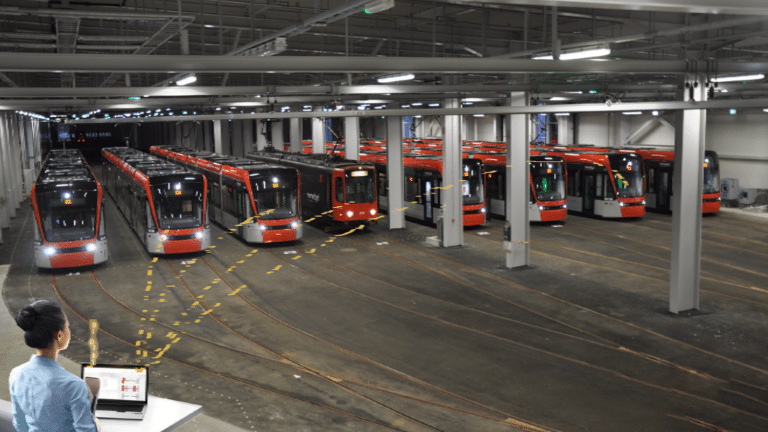
Im Mittelpunkt stehen ein neuer Radarsensor zur Hinderniserkennung (vergleichbar mit modernen Einpark- und Notbremsassistenten im Auto, jedoch für Schienenfahrzeuge und größere Distanzen ausgelegt) sowie ein funkbasiertes Ortungssystem, das die genaue Position der Bahn auch in Hallen oder schwierigen Umgebungen zuverlässiger als GPS bestimmt. Beide Datenströme laufen in einer Leitstelle zusammen, wo eine grafische Oberfläche die Position der Straßenbahn und das Radarbild der Umgebung zeigt.
Seit fast einem Jahrhundert haben sich die Betriebshöfe deutscher Straßenbahnbetriebe kaum verändert. Noch immer werden alle Fahrzeugbewegungen manuell durch Mitarbeiterinnen und Mitarbeiter ausgeführt. Dabei sind Fahrbetrieb und Rangierfahrten meist strikt voneinander getrennt. Straßenbahnen werden an festgelegten Übergabepunkten übergeben; Wasch- oder Wartungsplätze werden manuell angefahren. Auf einem durchschnittlichen Betriebshof legen die Beschäftigten täglich mehrere Kilometer zu Fuß zurück und führen rund 100 Fahrzeugbewegungen durch, die nicht der Personenbeförderung dienen.
Automatisierte Sicherheit und Effizienz durch Sensorik
Im Projekt VALESTRA wird ein System zum automatisierten „Valet Parking“ von Straßenbahnen auf Basis modernster Sensorik entwickelt. Ziel ist es, das Rangieren künftig sicherer, effizienter und teilautonom zu gestalten. Grundlage bildet die Betriebsordnung Straßenbahn (BoStrab), die einheitliche Signalbedingungen für Brems- und Fahrvorgänge vorgibt. Darauf aufbauend entsteht eine Schnittstelle, die den Gefahrenraum vor der Straßenbahn kontinuierlich überwacht und im Notfall selbstständig stoppt. Zum Einsatz kommen kombinierte Radar- und Ultraschallsensoren. Das Fraunhofer-Institut für Hochfrequenzphysik und Radartechnik FHR entwickelt dabei die Radarsensorik, die den Betriebsbereich präzise und störungsfrei erfasst.
VALESTRA trägt dazu bei, den Arbeitsaufwand auf Betriebshöfen deutlich zu reduzieren, die Sicherheit zu erhöhen und den Weg für teilautonome Straßenbahnoperationen zu ebnen.
Der heutige Stand der Technik in den deutschen Betriebshöfen von Straßenbahnen ist seit 100 Jahren nahezu unverändert. Die Fahrzeuge werden ausschließlich durch Mitarbeiterinnen und Mitarbeiter bewegt. Dabei erfolgt oft eine Trennung des Fahrbetriebs (Liniendienst) vom Rangieren der Fahrzeuge auf dem Betriebshof. Diese werden an einem definierten Übergabepunkt bereitgestellt. Des Weiteren werden Waschplätze oder sonstige Aufgabenpunkte manuell angefahren. Auf einem typischen Betriebshof bewältigen die Mitarbeiter jeden Tag mehrere Kilometer Fußmarsch und führen nahezu 100 Fahrzeugbewegungen aus, die nicht der Personenbeförderung dienen.
Gemäß der Betriebsordnung Straßenbahn (BoStrab) werden im deutschsprachigen Raum bestimmte Signallagen definiert, die das Bremsen sowie das Fahren einer Straßenbahn im Gefahrenfall sicherstellen. Auf Basis dieser universalen Grundlagen wird eine Schnittstelle entwickelt, welche mit auf die Bedürfnisse eines Schienenfahrzeugs angepasster Sensoren in die Lage versetzt wird, den zu befahrenden Gefahrenraum vor dem Fahrzeug sicher zu beobachten und im Gefahrenfall zu stoppen. Dafür soll eine Kombination aus Radar- und Ultraschallsensoren zum Einsatz kommen. Der Lehstuhl für Integrierte Systeme konzentriert sich dabei auf die Entwicklung der Radarsensoren.
Projektpartner
- Fraunhofer-Institut für Hochfrequenzphysik und Radartechnik FHR , Wachtberg (Konsortialführer)
- indurad GmbH , Aachen
- Tbmoto GmbH , Oranienburg
- Ruhr-Universität Bochum, Lehrstuhl für Integrierte Systeme, Bochum
Förderung
Dieses Projekt wird durch die Europäische Union und das Land Nordrhein-Westfalen im Rahmen des EFRE/JTF-Programms NRW 2021-2027 mit 2.189.288 € gefördert.
This project is supported by the "Europäische Union" and the "Landesregierung Nordrhein-Westfalen".

LumiTrack
Luminaire based asset tracking systems
Tracking of components, tools, and personnel is essential in realizing efficient and safe factories. Connected lighting is a ubiquitous and dense infrastructure ideal for use as a costeffective and highly accurate tracking platform in industrial settings.
Industrial processes involve the use of huge number of tools, parts and equipment. To be more efficient and safer, it is essential to track those accurately in real-time. In some industries, factories will need to be shut down unwantedly if serious incidents occur. Such incidents can lead to huge losses. Tracking technologies exist, but they are too costly to deploy in scale because of high installation costs. Luminaires are mounted at positions to maximize the illuminated area. They are at the ideal spots for tracking technologies to achieve best possible performance. Once tracking systems are integrated into luminaires, overall system cost (including deployment and maintenance effort) can be significantly reduced. LumiTrack project aims to make the convergence of lighting and IoT happen. The new products target two markets, namely the lighting and the emerging track and track markets, which have grown independently. Market surveys report that the current and future CAGR of both markets exceeds 25%, while the track and trace market size in 2015 was already $1.5B despite the fact it is costly to deploy.
Product Development
During the RD-Project LumiTrack indurad has developed the iRTT-AU-ML device and the iRTT-CP-TL product.
The iRTT-AU-ML is an infrastructure device for underground environments to track people for safety. It supports vehicle and personal location detection at underground crossings. The iRTT-CP-TL uses a RTLS-Tag (Real Time Locating System) that is built inside the lamp to keep hardware deployment simple and recharging processes smart.
Further more iRTT-AU-ML can be used as signaling device that informs with a bright light and different colors the miners whether a vehicle or person is around the corner. Optionally tunnel lights can be controlled to safe energy if nobody is around.
SponsorEIT (a body of the European Union)
Active Time01/2018 – 12/2018
Coordinatorindurad GmbH, Germany
PartnersSignify; KSE Lights; indurad GmbH
This project is supported by EIT Digital. EIT Digital is supported by the EIT, a body of the European Union.


Bots2Rec
The Robots to Re-Construction
In the Bots2Rec-Project, a semi-autonomous robotic system for the safe removal of asbestos residues from 1970s and 1980s housings and apartments will be developed. Despite the high availability and diversity of automation solutions in industrial areas, robots are rarely used in the construction sector. For this reason, the project partners develop new approaches and adapt already existing high-tech solutions in this area to protect construction workers from harmful substances and materials. The overall goal is to enable the cost-efficient renovation of old and contaminated housing all across Europe.
SponsorEuropäische Union (H2020 Forschungsprogramm)
Active Time02/2016 – 07/2019
CoordinatorRWTH Aachen (IGM)
Partnersindurad GmbH, Aachen; Robotnik Automation S.L.L., Barcelona; Eurecat, Barcelona; telerobot labs S.R.L., Genua; SIGMA Clermont, Aubière Cédex; Bouygues, Paris
This project is supported by the "Europäische Union" and the "Bundesministerium für Bildung und Forschung (BMBF)".